

Before the story; author's note
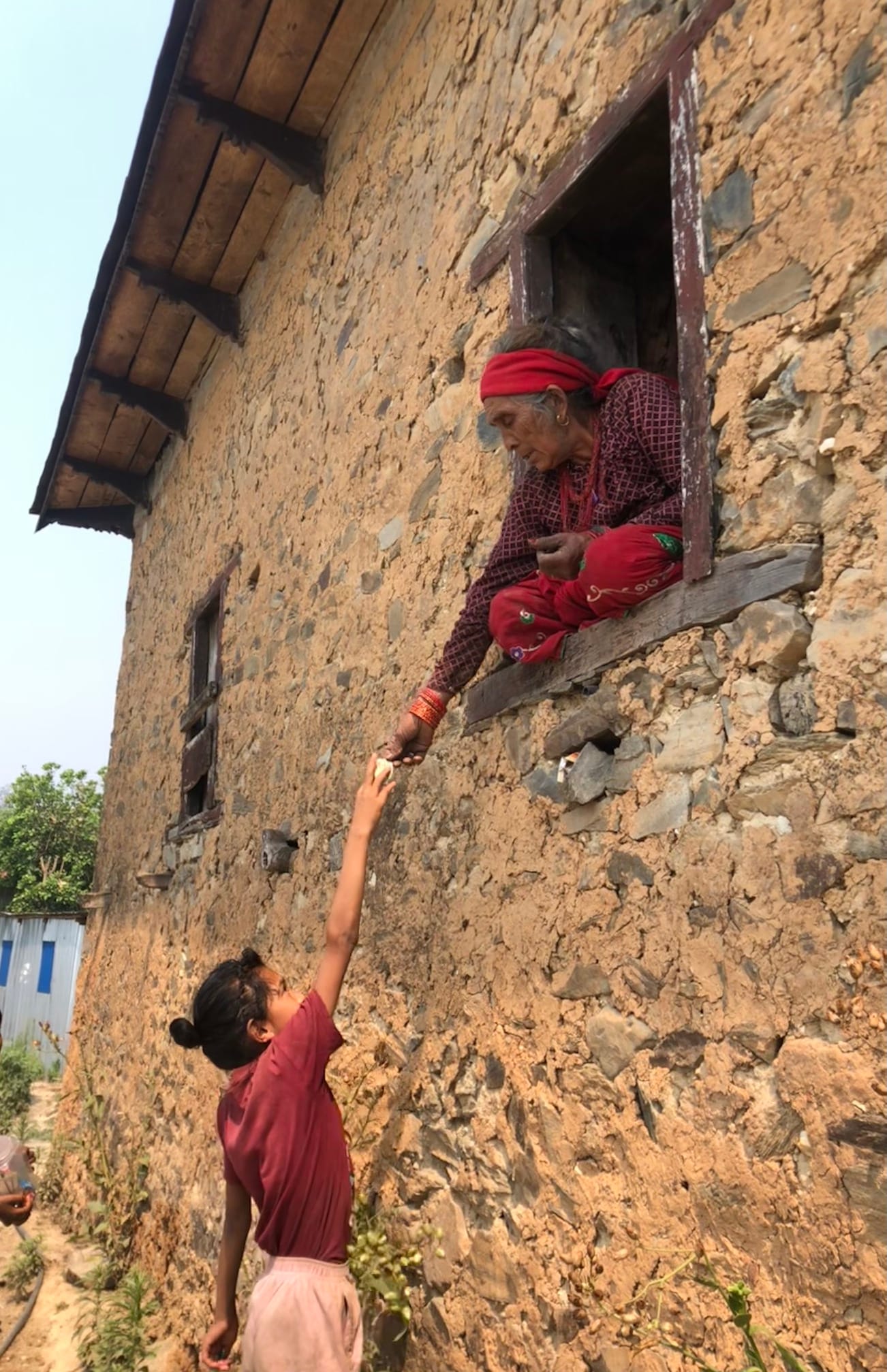
I met a grandma in 2024 when I was doing a storytelling project that gave me an opportunity to visit various places in Nepal. She was quiet at first. She would look at our faces and stare for a long time. I didn’t know what she was thinking, but she seemed clearly surprised to see a group of people drop suddenly at her place with the Jeep from Kathmandu. She didn’t talk much, but after a day or two, she started opening up. She would appear when we brushed our teeth in the morning and stay in front while we ate. And she asked if the food was good.
On the last day, we were surprised when she took out a madal and started drumming it in front of us. She even sang along with the melody. She had a big, powerful voice. She was bit worried that the harsh rain that day had loosened the leather of the madal and it didn't sound good as usual. With her song still lingering in our minds, we then returned Kathmandu, our first week of research done.
But the second time we visited, she was different. When we got off the jeep, she stood in front of us as if she had been anticipating us since the morning. There was a feeling of longing and warmth as if she was truly happy that someone she knew had returned.
The weather was hot in Kavre. Everyone in the village including grandma worried that their maize field had gone waste due to the lack of rainfall. The land had turned completely yellowish red. We couldn't really get out during the daytime. Our feet also started to look yellowish. So most days, my friends and I would stay at the homestay with the grandma. She would generously sit with us. One night when I was alone with her, she told me about the babies she had, the two sons, and surprisingly, we ended up talking about blood. I don’t remember how we reached to that topic. She said she bled heavily from between her legs that lasted weeks. She would wake up early in the morning before anyone was awake and wash away the blood. When she couldn’t endure it anymore, she went to the hospital and threw away her womb. It became a haunting memory for me whenever I thought about her.
I think, in that moment, when she was sharing with me the darkest period of her life, I couldn't ask questions but just let her be, listen to what she has to say. But I wanted to know how she felt losing her womb in the hospital. I wanted to know how she felt losing the chance of having a daughter. I wanted to know what she thought about her past.
I loved her, still do. It’s one of the reasons I decided to write about her, but it was quite limiting to write only the things I had seen or heard. So I wanted to use my own imaginative space for storytelling, to relate to her life or maybe just to make sense of the whole memories I had of her.
So this piece is the fictional story of a grandmother who is 70 years old. She is looking forward to her son’s return, but the sudden death of a young man in the village makes her nervous. It brings back all the memories of the deaths she has encountered in her life. She realizes how she still grieves for the life she couldn’t save, especially her third baby. This story is to show how memory is still part of the present and how it affects our everyday moments especially for older generations. Besides grandma, we were also drawn to a beautiful woman we met in Kavre. We loved how she laughed a lot while she spoke and how she was a full comedian. So this piece is the shared story of two women in Kavre, sharing the same place, the same fate.
It had only been a month since the news of the death last reached Phoolmaya’s house. Today, her neighbor whom she still called didi, though they were the two oldest grandmothers in the village, came breathless to her yard. “I heard the young man died on the way to the hospital,” she said.
“Young man, who?” Phoolmaya asked. She normally ignored news of death, but her heart skipped a beat when she heard it was a young man this time.
“The young man from the other village! I don’t remember his face well. But people say he was a truck driver from here.”
“The world has gone upside down…” Phoolmaya muttered, and went back to feeding grass to her Kali. It should have been us who should die, she thought, but didn’t say it aloud.
Didi was always nervous about death. “Who will look after the goats and buffalo when I die?”she always shouted the same question at midnight when her son stumbled home drunk. Phoolmaya would always watch Didi and her son shout at each other in the dark. Somehow, being the watcher amused her. It at least made her feel grateful that her own sons didn’t turn out to be like hers.
“Huh…” Phoolmaya almost chuckled.
“Are you laughing?” Didi snapped. She knocked her stick against the stones on the ground as if they annoyed her suddenly.
Phoolmaya leaned against the door and didn’t say a word. A quiet calm settled between the two women as if it was something they were already accustomed with. Phoolmaya looked down at her toenails, the red polish she had applied a month ago already fading. She stared at the tiny fifth toenail, its paint completely gone. There was nothing to be done, that little toe always stayed hidden under her foot anyway.
A moment later, a loud bus passed by them, full of people hooting. Dust flew all across the ground, into their yards, even onto their faces. Finally, Didi broke the silence. “People said it was because of the lack of wind that he died. Such a tragedy…” Didi said.
“The wind?” Phoolmaya raised her voice. “I felt something bad in the wind today. It was too harsh.” She remembered sitting under the tree in the morning, hearing the wind rattle through the branches, crying like a person. Now it made sense, someone had died.
“I heard they closed all the jeep’s windows. Pity that not a single person tried to open them.” “Were they trying to kill him?” Phoolmaya said, her irritation growing.
Didi coughed loudly and spat on the yard.
“You’re already old and sick. Go get your medicine if you don’t want to be the next one to die.” Phoolmaya said, more harshly than she meant.
“Whatever. The man already died,” Didi said as if all of a sudden the matter didn’t interest her anymore. Then she walked home.
When Didi left, Phoolmaya’s mind went back to the morning. She had sat outside watching the village bus rattle along the new dusty road of Charkilla, stopping at houses to pick people up. There was something comforting about knowing who left for the city and who returned.
Sometimes, a small envy pricked her, those people could go whenever they wished. If I hadn’t married a man from this hill, she thought, maybe I too would be in the city now, where a bus could take me anywhere I wanted. She knew the bus schedule by heart, when it appeared, when it returned. She waited for it as if it belonged to her. On the days it didn’t come, she found herself worrying. But now, thinking of the dead man, she felt almost ashamed of her longing for that road.
Someone died on this road, she thought. And now, her obsession with the road grew less, and even the hope that her sons would return began to fade.
Phoolmaya sat under the tree and put a leaf between her lips. Pep… pepp… A soft sound came out. She blew harder, but then it let out a big cough. After catching her breath, she tried again.“I can’t believe I’ve lost the strength in my breath…,” she whispered. Then, her mind drifted towards the dead young man again, in the jeep, struggling for air. A shiver ran through her thinking about his death.
I hope he don’t curse this road, she said. But more than that, she worried her sons might hear the news, and might change their mind of coming home.
Phoolmaya hadn’t seen her sons for almost three years. Just a month ago, Sandip had called, saying he would come during Dashain. “If you can, son,” she had said, her voice too careful. Almost formal. Whenever her son called, she couldn’t bring up the things she had been wanting to ask. The words stayed stuck in her throat. She wanted to ask him if he had bought the gold necklace he had promised to bring. But she was afraid it would sound too greedy, coming from a mother. Yet, she still imagined its cool weight around her neck, how she would show it proudly to the neighbors, and to say, my son loves me. But sometimes, she wished if her son had never made that promise at all.
It had all begun years ago, on a night Phoolmaya could never forget. She had not been ready then. Her son had shaken her awake in the middle of the night, whispering urgently, “Ama, I brought someone.”
“Who do you mean?” she asked again, almost praying that it wasn’t what she feared. “Your buhari. I brought her home,” he whispered, calm as if it were some ordinary news.
Phoolmaya’s husband snored loudly beside her, unaware. She remained silent and followed her son upstairs. “I brought you a daughter-in-law,” he repeated, as if it was her who had asked him to bring her one. There, in the corner of the room, she saw a young girl wrapped in a green shawl. She slowly tucked her legs inside the shawl as Phoolmaya watched. Something in her timid face struck her, a look she herself had once carried. In that instant, the years collapsed, and she felt as if she were staring at her own younger self.
“Dear god! I fear what is to come tomorrow,” she murmured. “Did you eat something?” Phoolmaya asked.
“We had noodles on the way,” her son said quickly.
“Fine. We’ll talk in the morning,” she said and went back to bed.
But Phoolmaya couldn’t sleep that night. Knowing her son was lying on a bed with a girl she had never met, a strange feeling grew inside her. In her mind he was still the same baby she had once held. For some reason, her children never grew in front of her eyes. Again, she pictured the girl’s timid face and let out a long sigh.
“Foolish girl,” she muttered into the dark.
The wedding was decided soon after. Preparations took over the house. In the rush, Phoolmaya sold her only buffalo, the one she had hoped would grow bigger. The feast went on for two days. By the end of it, she was too tired to stand. Watching the guest leave, in the window’s reflection, she caught sight of herself: her hair messy, her sari loose, her neck bare where her goldornaments used to sit. Her son came to her and said, “Mother, I’ll return the gold once we’re settled.” She didn’t say anything. She only glanced once more at the gold placed on her buhari’s neck. She smiled.
Nothing is truly mine, she thought. She remembered her own wedding day, when her husband had placed gold earrings on her. The next morning, he came to the kitchen and said, “We need to return the gold.”
“But you put it on me yourself…” she protested. “Never mind. I borrowed it. I must return it,” he replied. Even now she could feel the sting of that moment, betrayal mixed with disappointment, though he had bought her gold a few years later. Yet beneath it all, she still hoped her son might be different from the man she had married.
But today, Phoolmaya felt different. Perhaps it was the death that changed her mind. What should I do with the gold when I am nearing death, she thought. From the tree, Phoolmaya saw a crowd gathering at the dead man’s house. Women were standing outside with shawls wrapped around their heads while men rushed in and out of the house. She then looked at her own hands, dry and pale, as if she were seeing them for the first time. She pinched the skin of her finger. The flesh stayed lifted like a small mountain.
I don’t even have blood left, she thought.
“I think I’ll follow the dead soon,” she whispered. There was no fear in her voice, only a quiet sadness. Phoolmaya knew the feeling of death well, though she knew no one would believe her if she ever said it. So she kept it to herself. And each time news of someone’s passing reached her door, that same heavy feeling returned, like a sickness that never left. She knew how the senses disappeared, how the body became one giant rock, so heavy you couldn’t even lift a finger. How you drifted somewhere between heart and flesh. And if anyone asked whether death itself was painful, she would always say that losing someone you love was far worse than dying.
That day, when the water broke, she had trembled. She wept. She remembered women watching her from the door, some rushing up the stairs. One urged her, “Just endure it…” too lightly, then turned to the girls in the doorway: “What are you looking at? Bring the water…” As Phoolmaya pushed, she held onto her own flesh, and someone tried to unfasten her hands. She wept like a child. Soon, her senses began to fade. Her lips dried. She gasped for air. Faces blurred. Darkness swallowed everything. It was the long silence in the room that pulled her back. She opened her eyes and saw her cousin sister, sleeves rolled up, the red shawl wrapped around the baby. The baby is dead, they told. Phoolmaya remembered crying then, but no tears came. She had already cried enough. She fainted again. The next day her husband and cousin sister sat kneeling beside her. “The baby was already gone before it was born,” they told her. She said nothing. She pressed her swollen thighs with both hands and turned her eyes away. That was the day she became what she feared most. I should have died instead, she thought.
After that, the birth of her two sons brought pride to the family. But Phoolmaya waited patiently for the daughter. Sometimes she imagined the baby girl’s steps it would leave on the house. She imagined the two gold earrings she could make her wear instead for her future bride. But her dream stretched out dead while her womb started to bleed. She bled for days. She didn’tt know what was happening. Early at dawn, she woke and sped to the river to wash away the blood. As she saw the blood. there was something that urged her and made her think she wasn’t afterall, just a woman with a normal problem but something grieving held her. She chose herself. On that day, with her cousin sister, she threw her womb and also her whole dream of having a daughter again. As she reached home that day, she felt like as if she had secrets that she wouldn’t tell for the rest of her lives. For her sons, she became a mother who held secrets, a big sin she wouldn’t be able to wash. The memory still haunted her.
Kali moohed. She wagged her tail from the shed. Phoolmaya stood up and filled a bucket with water.
“Drink. Otherwise, you’ll die before me,” she teased.
Phoolmaya’s husband was still nowhere in sight. She lit the fire and set a pot of water to boil. She scooped a bowl of dhido flour and placed it beside the stove, ready to stir once the water bubbled. She liked dhido. Even though it had little taste, it was soft and easy to swallow. It did not trouble her teeth. At this age, you can’t eat everything, even if you have plenty, she thought.
In front of the stove stood a door Phoolmaya rarely opened, the door that belonged to her second son. That had been their tradition. After both sons married, the house was supposed to divide into two. Two doors for two sons. Now she barely knew what her sons would do. Maybe they won’t come back at all, she thought. But there was something about the house that never went away.
Memory. When Phoolmaya was alone, she drifted into the past more, and that memory laced with the door always came back.
Her sons’ house was usually quiet, except for the neighbor kids. But that day, it was loud.
Phoolmaya was returning from the jungle with a doko of fresh grass when she heard boys’ voices from far away. Suddenly, three young boys jumped out from the bushes, rifles on their shoulders, one with a red bandana. Fear gripped her, only Maoists wore red. They came out of her house. “Keep him inside!” an older man ordered them.
Phoolmaya knew it was pointless to protest, so she went in. She had heard in the news the maoist was occupying the villages. Then she saw her husband doing what they told him, handing over a knife when asked, yet showing no fear. “Ama, we won’t hurt you. We just need a place for a few days,” one said. Phoolmaya obeyed. Some boys stirred the dhido, some prepared plates. There was a man they had kept captive, but Phoolmaya barely noticed him. What caught her attention was the gold ring on his finger. For days, the Maoists stayed in the house, cooking, cleaning, even feeding her and her husband, but Phoolmaya hardly paid attention to them. She couldn’t stop looking at the ring, how it shone in the light. When the man asked for food or to go outside, she hardly heard him. All she saw was that gold on his hand.
But as days grew, she got curious about the man. One day, Phoolmaya asked him quietly, “What did you do, son?” his shoulders hunched. “I am a police officer,” he whispered. “Why are they keeping you here?” she asked. He looked down. “What does it matter now? I am waiting…” Tears ran down his face. A sharp whistle outside made them both flinch. “I killed one of them. Just doing my duty,” he said. Phoolmaya stood still, unsure how to react. Her attention kept going for his gold.
The next morning, two Maoists entered with rifles. “Ama, we are taking him to pee outside,” they said. They took him out of the door, inside the maize farm. A moment later, there was a gunshot. She remembered the cornfield, swaying forcefully on that day. The same door, sitting right in front of her, still sent shivers down her spine. That memory was the one thing that connected her and her husband, something only they had ever shared.
It still haunted her. The door was situated right across the stove, so was the memory. It was getting late. Her husband wasn’t home yet. Phoolmaya ground masala on the slate. “These men… they never say where they go or who they meet… They just leave and forget how to return,” she muttered.
Just then, the door banged open. “Ohh…here comes the devil,”.
Her husband stood in the doorway, holding a packet of chicken in one hand and removing his shoes with the other. From the size of the packet, Phoolmaya knew it was too much.
“This is a lot for just two people. Who will eat all of it?” she asked.
“We will. Why are you bothered?” he said. Phoolmaya could smell the alcohol on his breath.
After years with him, she had learned to let him do whatever he wanted and never ask questions. Drunk men did not like questions.
“Cook it yourself,” she said.
In his hurry, he lost the balance and fell on the ground, half body inside the house, half outside.
“Who told you to drink?” Phoolmaya snapped as she went to pick him up.
“At this age, when death is so close, you’re only making yourself suffer more,” she said. “What will our sons say if they see you like this?”
He dragged himself to the kitchen and lay down. Phoolmaya felt relieved that her sons were not there to see their father in this state. Yet at the same time, a small part of her wished they could see what she was going through.
When the whole village buzzed with news of death, a few houses away from Phoolmaya,
Cinderella was bothered by something else. She banged open the door harder than usual. Her two kids woke up in bed, shocked to see their mother standing at the door. She threw down her hat and the knife (to cut grass) on the floor, a little bit deliberately. She said in a loud voice, “The people in this house only know how to sleep and eat, while I am working like a servant here.” Kusum, the daughter, walked out of the room, her eyes half-shut.
“I told you to fill the water bottles. We won’t have water till evening,” she shouted again. By the stove, the fresh milk from the previous night was left uncovered. Cinderella, covering the milk with the plate, looking at her daughter, “Do I have only one hand?”, she said, sweeping back her front hair to the back, “I have so many works to do. The work is all over the house, even outside!”, she said with more anger. She added more fiercely, “Now I don’t know if I raised humans or the pigs.”
Kumsum lifted the broom and started sweeping the floor. She knew her mother had been acting differently since the night it happened.
“Murderer.” That was what the villagers called her now. It hadn’t bothered Cinderella much until this morning. She was walking home when she met two small children on the path. The moment they saw her, their eyes widened. One of them froze. The other pulled his friend’s arm and whispered, “Run… she’s the murderer. She kills people.”
Cinderella couldn’t stop them. She couldn’t ask the questions burning inside her, Who told you that? Did you see anything? Was it your parents? Somehow, hearing it from children hurt the most. But they ran off before she could say a word.
“What the hell…” she muttered in English. The strange part was, it almost made her laugh. Using a foreign word that the villagers didn’t even understand felt oddly funny.
Nine years ago, Cinderella arrived in Charkilla as a new bride. Everything felt new and exciting.
She especially loved the trees. In Kathmandu, she had only seen them from her rooftop. She would stand there and watch the houses scattered across the hills and imagine living in those quiet places, free to walk anywhere. The city felt full of watching eyes. Her parents tried to protect her, but their love sometimes felt like a cage she wanted to escape. When she reached Charkilla, she laughed after learning the villagers had never heard the name Cinderella. They called her Cindera instead. She told them the Cinderella story, and the villagers were surprised by how friendly the young bride was. “Do you know my name came from a beautiful princess?” she proudly told everyone.
Sometimes she liked to boast: “I was so beautiful that men in the city wrote me many love letters. I wore frocks of every color. I lived like a princess.”
Her favorite part of the story was always the prince carrying the girl away from her dull house. Sometimes she slipped in the English words she learned in school, “Exactly, that’s what I’m talking about,” or “By the way…” The villagers teased her for sounding too foreign, but instead of feeling shy, Cindera enjoyed it. It made her feel special.
Cinderella was outspoken. She also used humor to tell parts of her truth.
“When I came here, my husband had nothing more than a tin house,” she joked. “He told me he had a big house like a castle. I was fooled!” She laughed before anyone else could.
But over time, their love faded. The man who had once seemed steady and reliable started hitting her. After losing his driving job during COVID, he drank more, and violence became a part of their daily life. The children were often afraid. Cindera, in her mind, began imagining his death more and more. And on that particular night, he came with the nettles in his fist. Cindera dashed to the kitchen and grabbed a knife. For a fleeting moment, she thought of cutting him. Then, she hurled it across the room. It struck his knees. Blood spread across the floor, and the nettles fell from his hand. The house went silent. He froze, unsure what had happened. Cindera stood still too, a strange heat coursing through her, part triumph, part relief, that he was still alive.
By morning, the news had spread through the village that Cindera had tried to murder her husband.
The day after the incident, the women had gathered in one room. Cinderella’s story became the main topic, and they argued for a long time about whether she was right or wrong.
“It’s a big kind of violence for a woman to raise a knife at her husband,” one woman said. “You could have killed him. You could be in jail now,” another added.
That wasn’t what Cinderella had hoped for. She had wished someone would say she had done the right thing—that she had protected herself.
“I would also feel like killing my husband if he behaved like that,” another woman admitted softly.
“What will your children learn from all this? Think of them seeing blood, seeing you hurt someone,” an old woman said.
“A woman trying to kill her husband! It would be on every news channel,” another woman chimed in.
The next day, sitting under the same tree, Phoolmaya watched the dead man’s house. She couldn’t sleep the whole night. At this age, rest didn’t come easy. Surprisingly, she found herself fearing the darkness less. Dusk and the morning stars had become her companions, she would simply sit outside and watch them fade away. She dreamed less now, too. Most of the time, she lay wrapped in her shawl, combing her hair only when she felt like it, otherwise keeping it tucked neatly under the scarf. Sometimes, she wandered around the neighbors’ houses or went down to check the maize in the fields.
As the dawn wore on, the two children, Kanchi and Maya, approached Phoolmaya’s house. They were carrying a bottle full of chocolates.
Kanchi, the younger, stood in front of her. “It’s my birthday. You have to buy chocolates from us!”
“I have no money. Go away,” Phoolmaya replied.
“How come older people don’t have money?” Kanchi asked, teasing.
Phoolmaya touched her patuki and flipped it open. “See? I have none,” she said, chuckling at their disappointed faces.
“It’s just five rupees for one,” Kanchi pleaded.
The children dragged Phoolmaya inside, up the stairs, and made her get the money. They giggled behind her as they walked. “Grandma…did you know Surprisa’s brother brought a girl into the village?”
Phoolmaya turned, surprised. “Really?” The children’s excitement was contagious. “Did you see her? Is she pretty?” Phoolmaya asked.
“She is…” the kids paused for a moment, then continued, “fat fat, but white and fair,” one said. “And she’s wearing a pink kurta,” the other added.
The children disappeared shortly after getting the money. For a moment, Phoolmaya forgot her worries about death. Curiosity took over. Her mind rather drifted towards wanting to see the bride with her own eyes and watch her blush, not herself.
After giving Kali a bundle of grass, Phoolmaya walked to the peepal tree for the chance to see the bride, but she didn’t want to seem too eager. So she crouched on the slate beneath the peepal tree. The wind blew strongly as usual. From a distance, she saw her old friend, Sukumaya tending the coffee plants with one of her grandchildren. Sukumaya’s cornfields looked as empty as everyone else’s. The rain has no mercy, she thought. On the left, Kamal Bajey, her own age, with white hair, weaved a doko. It still amazed her that he could do it so perfectly despite his weak eyesight. He glanced at Phoolmaya and stared for a moment.
“Did you know there’s a new bride in the village?” she shouted, but the wind blew the words away.
“Huh…” he shouted back.
“Nothing…” Phoolmaya replied. Why must I bother the man while he’s working? she thought. Looking down from the Peepal tree, Phoolmaya couldn’t help but think about the life she had spent over six decades perched on these hills. “We have been fools. Who in their right mind plants maize on such steep slopes?” she thought, surprised at her own judgment today. Below, she spotted a mother carrying a baby on her back, another clinging to her legs. Phoolamaya squinted to see clearly and realized it was Sushila—the woman everyone called the most unfortunate wife in Charkilla. “Why don’t you just leave him?” Phoolmaya had once asked Sushila. “There’s nowhere I can go,” Sushila had replied. Looking at her now, Phoolmaya saw her own pain shrink to something small and bearable. She even forgot the betrayal of her husband, the lies about the gold, his drunken shouts. At least, she thought, he didn’t beat me every single day.
“Grandma…” someone called from behind the tree. Phoolmaya recognized the voice; it was Cindera.
Cindera set her bundle of grass beside the tree and also crouched down next to her. For a while, neither of them spoke. The wind whipped through Cindera’s hair. With Phoolmaya, she felt quiet comfort; she didn’t need to say anything wise. In her, Cindera saw a reflection of her own mother, the one she had lost too soon. The only thing that made Cindera easy nowadays was being out in the jungle. She forgot her pain in the trees. This morning, she saw her husband crouched near the alcohol room. His scars around the knees were healing. Cindera was ashamed of what she did, but still it didn’t change the way she felt about him. She had really wished if he had rather died.
“I’m in a good mood to die if someone asks me to,” Cindera said suddenly.
“Huh…” Phoolmaya chuckled.
“I only attacked him once and they are already calling me a murderer…,” Cindera muttered.
“It would have been better if he had died… haha… after all, you became a murderer,” Phoolmaya said, laughing.
“Yeah… I should have cut his throat…” Cindera laughed too. Something about the laugh eased the environment. Cindera wanted to just spill everything.
“You know what my husband told me when I met him for the first time?” Cindera said with a high tone, almost excitedly.
“He said he had a big building in his village,” she burst out laughing.
“Really? So you got your house now?” Phoolmaya teased, slapping her hand lightly. Both of them laughed harder.
“My husband gave me gold before the wedding, and the very next day he said it belonged to his uncle…” Phoolmaya shared. They erupted in laughter again. Silence settled afterward.
“We were fools…” Cindera admitted, swallowing the words.
“Yes… we were,” Phoolmaya replied. Something in that moment bound them, an unspoken connection, as if they shared the same fate despite the age difference.
“When I was in Kathmandu, I was trapped in that big house like a princess,” Cindera said.
Phoolmaya enjoyed listening, unsure how much of it was true; Cindera’s past always sounded fantastical. Yet she spoke with flawless confidence.
“You don’t even know, I once did acting in a Nepali movie,” Cindera added. “Are you serious?” Phoolmaya asked, aghast.
“I remember putting on makeup. The director kept yelling, ‘cut, cut.’ I nearly died from all the acting…” She demonstrated with her hands, laughing loudly. But to Phoolmaya, the laughter carried a hint of despair, a surrender to her present life.
“Cindera…” Phoolmaya said, her tone suddenly serious. “We have all suffered. When you reach my age, you’ll know what true suffering feels like. You become your own betrayal.”
Cindera tossed stones into the air.
“I’m afraid I’m dying soon,” she whispered. “My knees hurt, even my back…”
“But how can someone call me a murderer when I haven’t even killed him…” Phoolmaya laughed again, knowing that was all she could offer her.
Just then, a group of boys approached the peepal tree. One carried a doko, another a hen tied in a sack. One wore a nice outfit, they all looked like they were off for mischief. Phoolmaya and
Cindera recognized Aryan Sir, the village teacher.
“Where are you going? With a gang of boys?” Cindera asked.
“We’re going to the new Behuli’s house to ask for her hand,” the teacher replied. The others stopped, eager to answer the curiosities ahead.
“How’s Behuli?” Cindera asked. “She is pretty,” one boy said.
“What if you can’t convince Behuli’s parents?” Phoolmaya teased from behind.
“So what? The mother-in-law once ran away from home too. Why should this be a problem?” the boy replied. The group laughed loudly as they walked away.
Phoolmaya didn’t say anything, but a smile played on her face. “Talk wisely to the Behuli’s parents, then…” she said. Everyone cheered. Someone had brought a soundbox, blasting a
Nepali song. The music gave the boys confidence, a promise of victory over the other village.
“Ah… marriage…” Cindera sighed. The group distracted them, and for now, all they could do was watch from a distance and reflect on how far they had come.
Member discussion