

Author's note:
The piece is set in a hospital, and it is an account of my observation of the kind of support patients had with them during their hospital visit. With this piece, what I wanted to reflect on was how having a person as support beside you during illness (be it physical or mental) means for the patient. In a way, I was also trying to reflect the toll it takes on a person’s mental health when they are physically ill. Likewise, the importance of emotional support for patients is also something that I was trying to get through the piece.
Hospital is the last place I want to be at. It brings all the unpleasant memories of the endless hours that I have spent in the past in waiting lines, laden with anxiety about what the doctor might say, and coming out of the place with no definite answers, and sometimes statements like, “I don't know how to help you.” This time it’s the different hospital, but the feeling is the same—tired of waiting. Waiting for time to turn around, waiting for someone to tell me what is going on with my body and lead me to the path of healing. It’s been six years since my symptoms of undiagnosed chronic pain and discomfort started, yet I have no name for it. It’s not that I did not try to find the identity of this unpleasant intruder, but after seeing five or six health professionals, I gave up hope of having it named. I instead tried to coexist with this intruder, and somehow I managed to do so over the years. I managed to tame it so that it wouldn’t shake my world, but this time it came at me with force, leaving me alarmed.
Today, again, I am here in this waiting area in hopes of having it named and eventually finding a way to get rid of it, or at least having an idea of how to deal with it when it starts creating havoc.
C010, that’s my token number. “Your turn is after nine people. Please wait for your turn,” the coupon says. I know I will be sitting on the same seat, waiting for hours. I look around me. There are many people like me, I assume, waiting for their own answers or looking for solutions or relief from their suffering. An elderly man, probably in his 50s, is dozing off on his seat, his head tilted on his shoulder. There is another middle-aged lady beside me who is constantly looking at the red numbers sliding across the display board. She is quiet. I wonder if she is alone like me.
I am usually by myself. In the beginning, I had asked my family to accompany me to the hospital. As time passed, they started to disappear. I heard multiple “bhyaudaina” (not available), or them implying that I was making a big deal out of simple health discomforts. Since then, I started making the visits alone, even though I wished for someone beside me every single time.
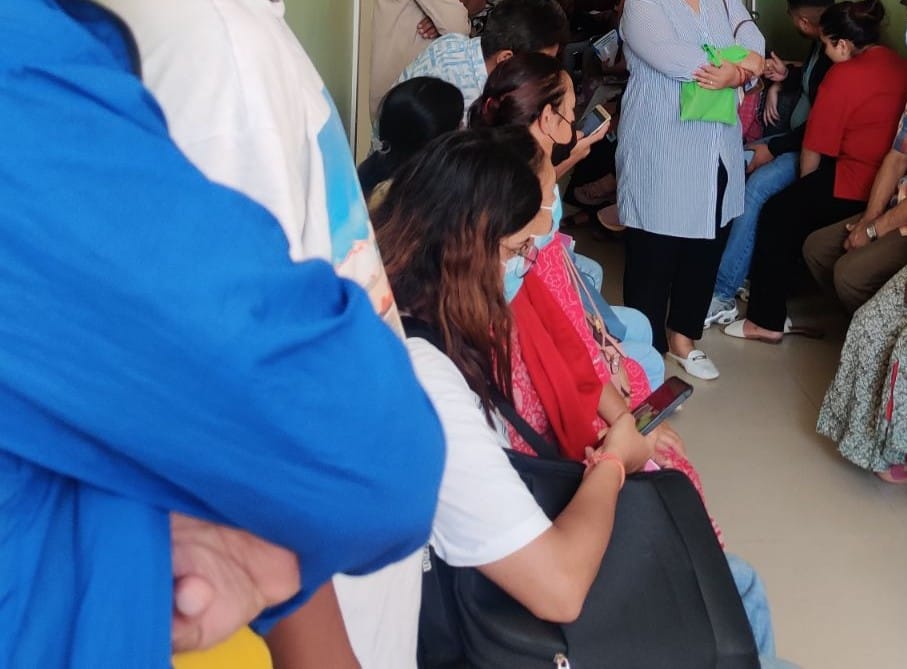
There is some shared experience in the hospital. It feels like all of us are waiting for the same thing, unsure of our bodies. We are probably among the few people who are in their own worlds, waiting until the name of the patient is called.
I keep looking at the people around me. My attention falls on a middle-aged couple. The husband is fixated on his phone. He has a frown on his face the entire time. The wife isn’t speaking. She seems as if she is zoning out, but a few moments later, she lies down on the attached seats and falls asleep. The husband walks outside. Whether the frown on his face comes from concern for his wife or simple annoyance, I cannot tell. Once their turn is called, the husband comes inside and wakes his wife. He takes the bag with her medical records. The wife stirs awake. At first, she tries to make sense of her surroundings, places her hands on her head for a few seconds, making it look like she is having some headache. She stands up regardless, carries her handbag, and heads out towards the consultation room. There is no exchange of warm words or gestures between the husband and the wife. In fact, there is barely any interaction at all, even until the end. Watching them, I am reminded of my own parents. My mother, who struggles with a series of health issues herself, never likes going to hospitals with my father because of his aloof, distant nature, his lack of expressed care, and sometimes his lack of sensitivity, too.
“Ta jaile ko aestai ta hos ni,” [You are always like this] she repeats the statement made by my father. “Malai kasto naramro lagchha. Dui sabda talai k bhayo bhanera sodhnu hunna, aja aesto bachan launu hunchha.” [It makes me feel really bad. He doesn't even ask how I am, yet, he says things like this] She has shared this with my brother and me many times. I don’t know if the couple I am seeing in the waiting area shares the same equation as my parents. But the care and warmth one might expect for someone struggling with illness is not clearly visible to an outsider like me. After the husband and the wife disappear behind the door, the rest of us wait again.
Finally, the elderly man gets up after his number gets called. A woman stands up along with him, carrying his medical records, and follows him to the consultation room. He isn't alone either. It seems like everybody there is with someone. The middle-aged lady who has been sitting beside me starts talking to the guy next to her, a young man probably in his twenties. There is formality in their interaction, which makes me assume they may not be immediate family members. It makes me feel happy that she has someone to help her navigate the hospital bureaucracy when she isn’t at her best.
Another woman of about the same age takes her seat after the middle-aged woman is called for her turn. She looks restless, clearly uncomfortable. I take a chance to speak with her briefly, feeling a bit of relief that I can talk to someone. She says she has already undergone two surgeries for tumors and is here to consult a doctor about radiotherapy and medication. As she is sharing this, her sister returns and says that the doctor is not in the hospital, and the management is unsure when he will join. I keep looking at them, already feeling worried about them. Her sister looks lost and frustrated, trying to figure out what to do next. Then, she takes her sister’s hand and walks towards the emergency department instead.
Finally, after two hours, my number gets called. I go inside to talk to the doctor. But I cannot help thinking about the patients I witnessed, wondering what waiting meant for each one of them. Seeing them makes me think about gestures- how gestures of care come in different forms. It may not seem like a big gesture. But for someone who is ill or struggling with their health, and I say this as someone who has been both a patient and an attendant, even something as small as holding a hand while walking can mean a great deal.
Member discussion