

Author's note:
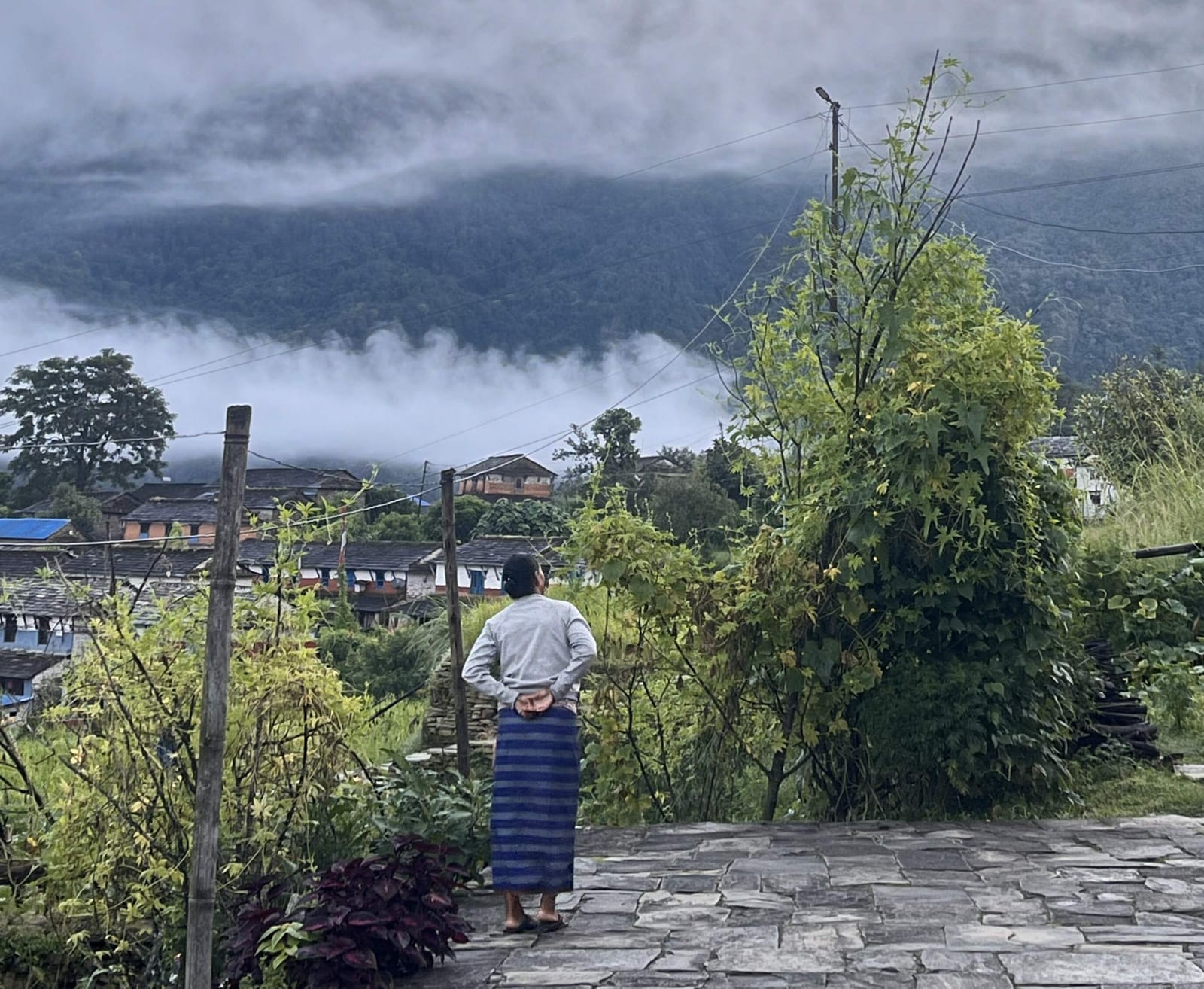
Around the time when the monsoon was ending and autumn was slowly arriving with clear blue skies, I reached a small village in Parbat for a week-long writing retreat. There, at the homestay, I shared a home with Maili Ama, and a man who was quiet chatty for his nature. We all called him Baje. I assumed Maili Ama and Baje to be a husband and wife when I first met them. But as I spent more days with them, I noticed Maili Ama addressing him as “bhai” [younger brother] which was one of the reasons why I got curious about Maili Ama’s life. We would sit and talk as we ate, our conversations moving from the stories of Maili Ama visiting Kathmandu to them learning to navigate the smartphones. From these talks, I got to know that Maili Ama was never married and has no children.
This memo is written from that one evening when I sat with Maili Ama, and we talked about marriages, love, children, and also the quiet fear of living alone in the hills.
One chilly evening, as the sky began to fade from blue to deep night, I found myself sitting with Maili Ama on a long wooden bench of her house. Her hands, roughened by years of labor, rested calmly in her lap. She moved her hands softly as she spoke. With gentle fondness, she told me about her three baby goats.
“The mother goat,” she said, her voice soft and low, “fed only two of her babies. The third one was left out and followed me everywhere I went.” Her lips showed a soft smile as she said it. “I had to feed it with a bottle. Sometimes, I’d put it on my lap because it was too lovable. What else could I do?” she said, showing me the way she used to place the baby goat on her lap as if it were still there. As she spoke, the cold air wrapped around us, and the soft chorus of crickets filled the silence between her words. Her lungi, worn and familiar, was tied tightly around her waist. And her silver-streaked hair, pulled back neatly from her face, was gently lit by the warm glow of the kitchen light. The way Maili Ama recalled the memory of feeding the baby goat from a bottle and letting it curl into her lap reminded me of a mother with her child. It made me think of how care and nurture can take many forms, and perhaps it was what nudged me to ask about her own life and the choices she made.
There was one question that I had been wanting to ask Maili Ama from the beginning. As the night deepened, I asked why she had never married. She paused. At that moment, I couldn’t tell anything, but her eyes looked distant and steady. Then, she said softly, “There were people….they came asking for my hand. But I didn’t go. When I was young, I worked in the fields. There wasn’t time.” She moved her hands as if gesturing toward the vast land she had tended. “After that, my parents got sick. I had to care for them. Later, there were still people, but I said no. I won’t get married. K garnu garera, what’s the point? If you marry, you have to listen to them.” She rested her hand gently on her lap, and there was a moment of silence between us. Then, she continued, “Some women marry and do well. Others... not so much. I feel like my life is better. I don’t have to listen to anyone. I live how I want.”
When I asked if she ever wondered about what might have been if she had married, she replied, “Sometimes, yes. I feel like I should have gotten married when I was young. But once you’re older, it’s not possible. In old age, I just hope I die in peace. (Hidda hiddai marey huncha) If I get sick and someone has to take care of me, that would be a hassle. That’s all I worry about. Otherwise, it’s all good.” Do you ever wish you had children?, I asked, following up, and she gave me a smile in return. She said, “I have my nephews and nieces. They are like my children.”
I wondered if talking about this might make Maili Ama uneasy, but as she spoke, her words came slowly and clearly, with an occasional glance toward me that seemed as if she was inviting me to listen to her.
During the week I stayed with Maili Ama, I caught glimpses of her life beyond the time we would just talk. Even before the sun appeared, I would find her already sweeping the front yard, heating water over the fire, and preparing breakfast. In Maili Ama’s daily morning schedule, the soft clucking of hens marked the start of her day, and then there was the steady hum of the radio as she performed her morning chores. Each morning, she would serve food to us and Baje first, and then she would quietly reside in a corner and eat only after we had finished. I only saw fragments of her routine, but somehow they spoke to me about the life she had built around the house and also around the people she shared her house with. Unlike now, she shared there was a time when she lived alone, and as soon as the shadows grew long across her house, she would lock the door. “I am a woman living alone, so I had to take caution,” she explained. “In those days, if someone asked me if I was alone, I used to say no, there are others.” Some days were more frightening than others, when leopards would snatch stray dogs right at her doorstep. She would feed the dogs that came near, and once they were done, she would carefully shoo them away.
As I came back from the retreat, I kept thinking about Maili Ama. I was struck by her strength to live alone, something we wouldn’t expect from a woman living in the village, unmarried and alone. There was something in her story that made me realize that she didn’t follow the path that is expected for a woman by the society. I didn’t have the chance to see her entire life, but during that short period of time, I got to know how she lived her life through the care she gave to her guests, to her family, and even to her animals. In her, I saw a woman living the life she shaped for herself that might not fit society’s expectations but is nonetheless whole.
Member discussion